A commercial lease that runs more than a year or two usually says how the rent will rise. The two main ways are fixed increases, set in the lease, and increases tied to an inflation index, usually a version of the Consumer Price Index (CPI).
Neither is better in general. They split the risk of inflation differently between landlord and tenant, and the details of the clause can matter more than the choice between them.
Two ways rent goes up
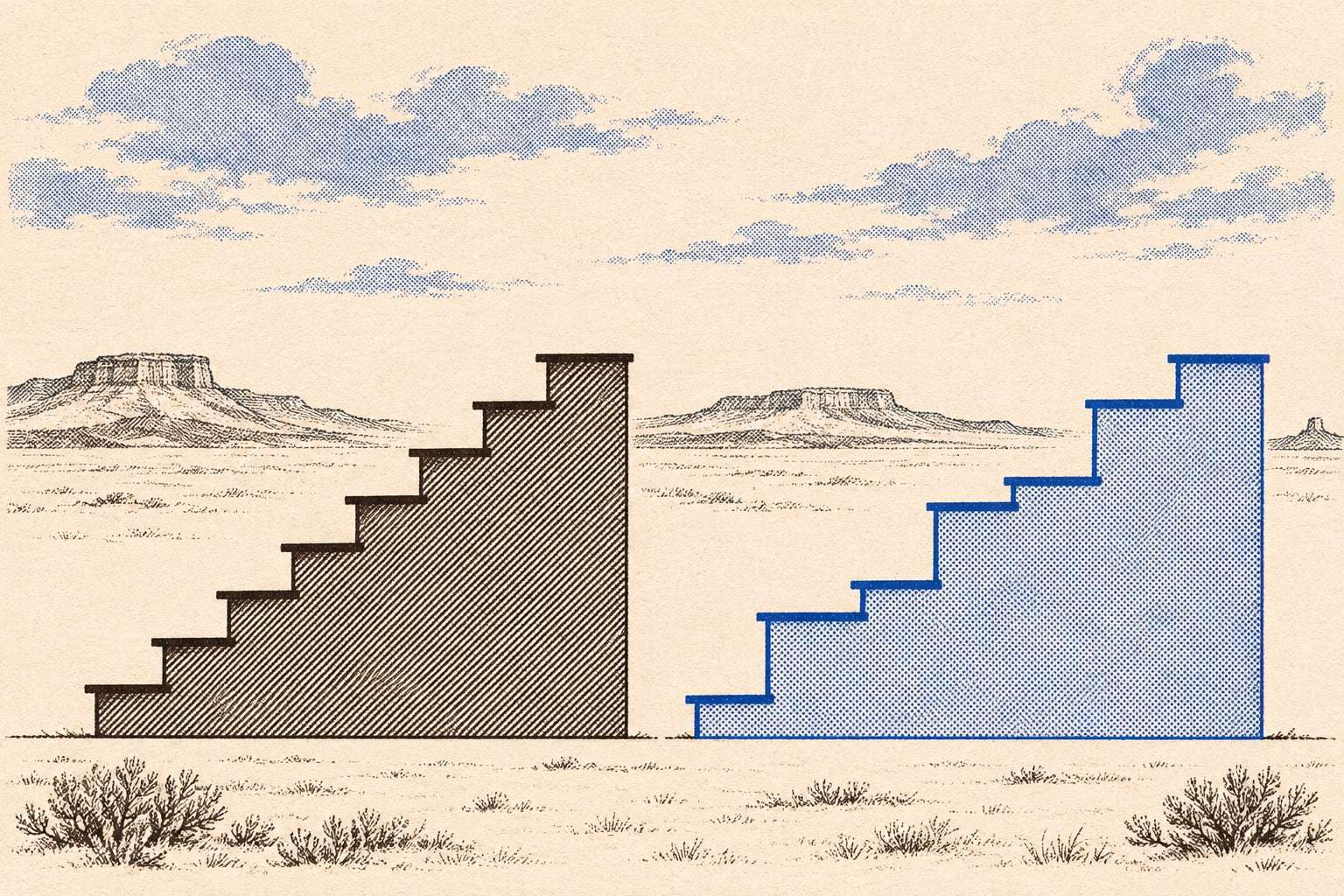
A fixed escalation names the increase in advance. It can be a percentage, such as 3% a year, or a dollar step, such as $0.50 per square foot a year. Both sides know the rent for every year of the term on the day they sign.
A CPI escalation ties each increase to the change in a named price index over a set period. Nobody knows the future rent at signing. Both sides know the formula.
How a fixed escalation works
A percentage increase compounds: each year’s rent is the prior year’s rent times the increase. On a $20.00 starting rent at 3% a year:
- Year 2: $20.00 × 1.03 = $20.60
- Year 3: $20.60 × 1.03 = $21.22
- Year 5: $22.51
A dollar step does not compound. At $0.60 a year from $20.00, year five is $22.40, slightly less than the 3% schedule, and the gap widens over a longer term.
That is the whole calculation. The appeal is certainty: a tenant can budget it, and a landlord can show it to a lender.
How a CPI clause works
The usual formula compares the index at two points in time:
New rent = base rent × (current index ÷ base index)
Say the base index was 300.0 when the lease started, and the index a year later is 309.0, both illustrative:
309.0 ÷ 300.0 = 1.030
$20.00 × 1.030 = $20.60
The clause should answer several questions the formula leaves open:
- Which index? The publisher, the series and the region, named exactly.
- Which months? The base month and the comparison month, often a few months before the adjustment date because index figures are published with a lag.
- Applied to what? Usually base rent only, not taxes or CAM.
- Up only? Whether rent can fall if the index falls.
- Year by year, or from the start? Whether each increase is measured from last year or from the original base, which matters once caps are involved.
Floors, caps and collars
A CPI clause can limit the swing in three ways:
- A floor sets a minimum increase, such as 2%, even if the index barely moves. It protects the landlord in quiet years.
- A cap sets a maximum, such as 4%, even if the index jumps. It protects the tenant in hot years.
- A collar is both. The increase is the index change, but never below the floor or above the cap.
Caps come in two kinds. A non-cumulative cap is applied year by year, and any excess is lost. A cumulative cap lets the landlord carry the excess forward and recover it in a later, quieter year. The second can feel like a cap and behave like none.
A cumulative cap, worked
The numbers here are illustrative. Take a $20.00 rent with a 4% cap. The index rises 2%, 2%, 7% and then 1% over four adjustments.
The first two years are under the cap, so both clauses give $20.40 and then $20.81. In the third adjustment the index rises 7%, and both clauses stop at 4%, for $21.64. The two clauses part ways in the fourth:
- Non-cumulative: the 3% excess is gone. The index rose 1%, so rent rises 1%, to $21.86.
- Cumulative: the 3% carries forward. The 1% rise plus the 3% carried is 4%, which the cap allows, so rent rises to $22.51.
The difference in year five is $0.65 per square foot. On 5,000 square feet, that is about $3,250 a year, and it carries into every later year of the term. Same cap, same index, different word in the clause.
Five years, three ways
The numbers here are illustrative. Say a tenant leases 5,000 square feet of office space in Cheyenne for five years at a starting rent of $20.00 per square foot. Compare three escalation clauses under two made-up inflation paths:
- Quiet path: the index rises 1.5% each year
- Rising path: the index rises 2%, then 3%, then 7%, then 6%
| Escalation clause | Year 5 rent, quiet | Five-year total, quiet | Year 5 rent, rising | Five-year total, rising |
|---|---|---|---|---|
| Fixed 3% | $22.51 | $530,914 | $22.51 | $530,914 |
| CPI, no floor or cap | $21.23 | $515,227 | $23.83 | $538,633 |
| CPI, 2% floor and 4% cap | $21.65 | $520,404 | $22.73 | $529,955 |
Read across the rows:
- Fixed 3% costs the same in both worlds. In the quiet path, the tenant pays $15,687 more than an uncapped CPI clause would charge. In the rising path, it pays $7,719 less.
- Uncapped CPI has the widest range, from $515,227 to $538,633. That $23,406 spread is the inflation risk, and the tenant carries it.
- The collar narrows the range to $520,404 to $529,955. The floor lifts the quiet years and the cap trims the hot ones.
The year-five rents matter too. If the lease has a renewal option at a percentage of the final year’s rent, a higher year-five rent carries into the next term.
Escalations and building value
For a landlord, escalations do more than raise this year’s rent. On a net lease, base rent is close to the landlord’s income, so the escalation clause sets how fast net operating income grows, and that feeds the building’s value.
Take the year-five rents above. Under the quiet path, fixed 3% gives $22.51 and uncapped CPI gives $21.23. On 5,000 square feet:
($22.51 less $21.23) × 5,000 = about $6,400 of income a year
At an illustrative 8.0% cap rate:
$6,400 ÷ 0.080 = about $80,000 of value
A buyer in year five will price the rent in place, not the one the landlord hoped inflation would bring. That is one reason an escalation clause deserves the same attention as the starting rent.
Escalations at renewal
An escalation clause covers the original term. A renewal option may set its own increases, repeat the original ones or say nothing at all. If it says nothing, the parties may disagree later about whether rent stays flat for the whole renewal term.
Read the option and the rent clause together, and record both in the abstract. If you are heading into a renewal, our article on renewal options when the market moves covers how the new starting rent is set.
Which one suits whom
A tenant with thin margins and a fixed budget may prefer fixed increases, even at a slightly higher expected cost, because the number never surprises. A tenant whose own prices rise with inflation may be comfortable with CPI, since its income and its rent tend to move together.
A landlord holding for the long term may want CPI to keep the rent’s buying power. A landlord planning a refinance may prefer a fixed schedule that a lender can underwrite without forecasting inflation.
None of this is investment or tax advice. It is the arithmetic of who carries which risk. Your CPA can say how either structure affects your own books.
Read the clause twice
Before signing or renewing, check:
- The index is named exactly, with publisher, series and region
- The base month and comparison month are stated
- The adjustment date matches the rent schedule
- Any floor and cap are stated as percentages, and their kind (cumulative or not) is clear
- The clause says whether rent can fall
- It says what happens if the index is discontinued or rebased
- It applies only to the rent you expect, usually base rent
- The renewal option says how escalations work in the new term
A clause that misses two or three of these can still be workable. It is just harder to calculate, and harder to argue about later. Drafting the fix is your attorney’s work.
Run your own numbers
The lease cost calculator shows what any escalation schedule adds up to over the full term, so you can compare a 3% fixed increase with a collared CPI clause on your own rent and square footage.
Price it before you sign
If you are weighing an escalation clause in a new lease or a renewal, a renewal and negotiation brief prices each structure on your lease, benchmarks it against the market and sets a walk-away number, in 7 business days from $2,000 per lease (indicative). It is part of our lease analysis service, which also covers abstracts and CAM reviews. Book a free 30-minute scoping call with the draft or the current lease in hand.